

 English
 русский
 Español
A flexible shaft is a mechanical device that transmits rotary motion between two misaligned or awkwardly positioned points. Often called a universal flexible shaft for its ability to route power around obstacles, this component eliminates the need for complex gears or rigid linkages. It consists of a rotating wire core surrounded by a stationary protective casing, allowing torque to flow along a curved path while the outer sheath stays fixed.
What Is a Flexible Shaft?
When asked what is a flexible shaft, the simplest answer is that it is a bending drive element. At its heart is a core made of multiple layers of high‑tensile steel wire wound helically around a central mandrel. This layered construction, often with alternating winding directions, gives the shaft its torque‑carrying strength while preserving the ability to bend to a tight radius — typically down to 15–20 times the shaft diameter.
The core runs inside an outer casing lined with a low‑friction liner, and the assembly terminates in end fittings that connect to a motor and a driven tool. Because the outer casing absorbs reactive torque, the shaft can snake through tight spaces without transmitting twisting forces to the operator or surrounding machinery. This fundamental design makes the flexible drive shaft a practical solution for remote rotary actuation in countless machines.
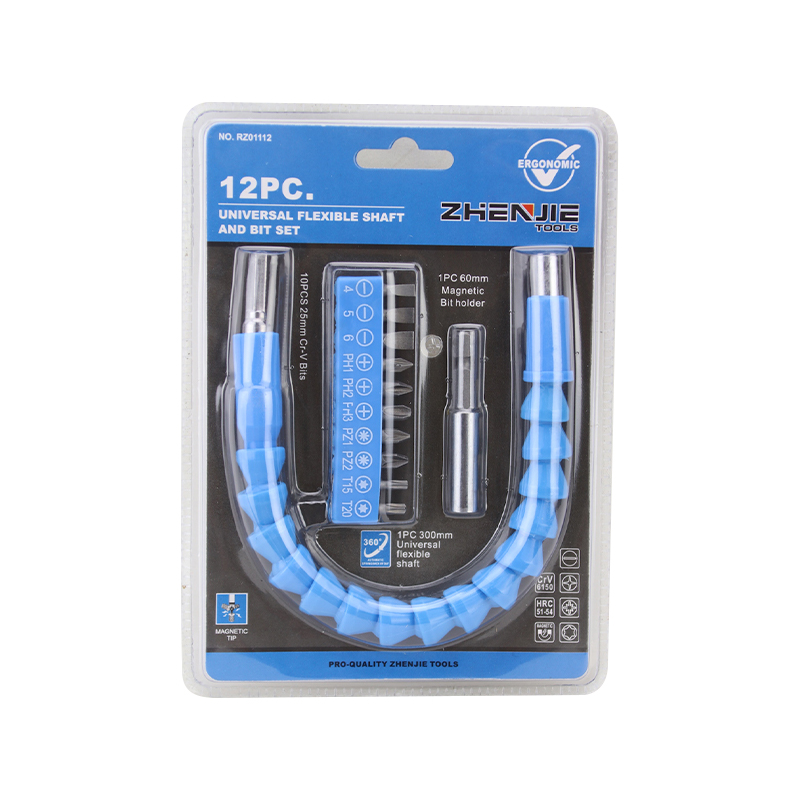
Types of Flexible Shafts
Understanding the types of flexible shafts is essential for matching the right shaft to the right job. Shafts are generally classified by their core construction and rotational characteristics, which directly affect torque capacity, flexibility, and service life.
| Common types of flexible shafts and their typical characteristics | ||||
| Type | Core Construction | Torque Direction | Typical Flexibility | Common Use Case |
| Unidirectional | Single‑layer spiral wire | Clockwise or counter‑clockwise only | Very high | Low‑torque remote adjustments |
| Bidirectional | Multi‑layer, alternately wound wires | Both directions equally | High | Flexible shaft for power transmission in tools and machinery |
| Heavy‑duty | Thick multi‑wire with reinforced casing | Bidirectional, high torque | Moderate | Agricultural and construction machinery drives |
| Hollow core | Tubular core with central passage | Bidirectional, lower torque | Very high | Light‑duty rotary tools and remote actuation |
The bidirectional multi‑layer core is the most widely used flexible drive shaft configuration because it handles equal torque in forward and reverse — a requirement for most flexible shaft for rotary tools and industrial equipment. For pure unidirectional tasks such as manual valve adjustments, a simpler and more economical unidirectional shaft suffices.
Flexible Shaft Applications and Uses
The flexible shaft applications span dozens of industries, from precision medical devices to heavy construction machinery. Any situation that demands rotary motion delivered to a hard‑to‑reach location is a candidate for a flexible shaft solution. Below are some of the most common flexible shaft uses in practice.
- Flexible shaft for rotary tools: Die grinders, pencil grinders, and rotary burrs often use a shaft to separate the motor from the handpiece. This reduces operator fatigue and allows working in tight spaces. A typical flexible shaft for a rotary tool can transmit speeds up to 30,000 rpm while weighing only a few hundred grams.
- Automotive and aerospace: Mechanical speedometer and tachometer drives rely on flexible shafts to transmit rotation from the transmission or engine to the gauge cluster. In aircraft, flexible shafts operate flap actuators and valve controls in confined fuselage areas.
- Medical and dental equipment: Dental handpieces are driven by ultra‑thin flexible shafts that can reach 400,000 rpm, enabling precise cutting without a bulky motor at the tip.
- Industrial machinery: A flexible shaft for machinery is frequently used to drive conveyor rollers, mixer paddles, or remote valve actuators, often where rigid shafting would require multiple gears or universal joints. Torque capacities in these applications range from 1 Nm to over 2,000 Nm.
- Power transmission in harsh environments: A flexible shaft for power transmission can pass through bulkheads, water‑tight seals, or high‑vibration zones while isolating the drive motor from the load, reducing overall system complexity.
Flexible Shaft Advantages
The flexible shaft advantages become clear when you weigh the alternatives. Compared to rigid shafts, belts, or gear trains, a flexible shaft can dramatically simplify a design, save weight, and lower both initial and maintenance costs. The key benefits include:
- Misalignment tolerance: Absorbs angular and offset misalignments without the need for precision alignment, reducing installation time and cost.
- Vibration isolation: The twisting core and casing dampen torsional vibrations, protecting connected components from fatigue damage.
- Packaging flexibility: A single flexible assembly can replace multiple universal joints and support bearings, saving up to 30–40% in weight and freeing up valuable design space.
- Low maintenance: With a sealed, permanently lubricated core, many flexible shafts operate for thousands of hours without servicing — an advantage in inaccessible locations.
- Cost efficiency: For moderate‑torque applications, a flexible shaft system can cost 20–50% less than an equivalent arrangement of rigid shafts, gears, and couplings.
When selecting a flexible shaft for machinery or portable tools, it is this combination of mechanical simplicity, reliability, and compact routing capability that makes the universal flexible shaft an enduring choice in modern engineering. Whether spinning a flexible shaft for rotary tools at high speed or driving a slow‑turning agitator, the technology delivers rotary power exactly where it’s needed, no matter how convoluted the path.