

 English
 русский
 Español
Different Types of Screwdrivers: A Complete Guide
Screwdrivers are defined by the drive type they engage — the geometry of the recess or socket in the screw head — and by the handle and mechanism design that determines how force is applied. There are far more than two types of screwdrivers in active use; understanding the full range prevents tool damage, stripped fasteners, and the frustration of using the wrong driver in a critical application.
Flathead (Slotted) Screwdriver
The flathead screwdriver engages a single straight slot across the screw head. It is the oldest drive type still in common use and the most prone to cam-out — the tendency for the driver to slip out of the slot under torque, damaging the screw head and the surrounding surface. Flathead drivers remain common in legacy electrical work (terminal screws, conduit fittings), furniture hardware, and decorative applications where the slotted aesthetic is intentional. They come in cabinet (narrow blade relative to shank), keystone (blade widens toward the tip), and flared variants.
Phillips Screwdriver
Phillips is the most widely used drive type globally, identifiable by its cruciform (cross-shaped) recess with angled flanks that intentionally cam out under high torque to prevent overtightening in assembly line applications. Sizes run from PH0 (smallest) through PH4 (largest), with PH1 and PH2 covering the vast majority of consumer product applications. Phillips is sometimes confused with Pozidriv — a related but distinct drive that adds secondary radial ribs between the cross arms for better bit engagement and far less cam-out.
What Is a Torx Screwdriver?
A Torx screwdriver (also written as TORX, a registered trademark of Acument Global Technologies) uses a six-pointed star-shaped drive recess. The geometry distributes torque across six contact lobes rather than four or two, dramatically reducing the cam-out tendency of Phillips and flathead drives and allowing significantly higher torque transfer without stripping. Torx sizes are designated with a "T" prefix: T1 through T100, with T10, T15, T20, T25, T27, and T30 covering the most common fastener applications.
What are Torx screwdrivers used for? Torx fasteners appear in automotive applications (brake caliper bolts, engine components, interior trim), consumer electronics (laptops, smartphones, game consoles), bicycle components (disc brake rotors, stem bolts), and appliances. They are increasingly specified by manufacturers who want to prevent casual disassembly — either for product security reasons or because the application genuinely requires controlled torque that Phillips cannot deliver reliably. A security Torx variant (Torx Plus Security, sometimes called tamper-resistant Torx) adds a central pin in the recess that requires a hollow-tipped bit to engage, specifically to deter unauthorized access.
A Form of Screwdriver Used on Electronic Equipment
Electronics work relies on several specialized drivers beyond standard Phillips. JIS (Japanese Industrial Standard) screwdrivers look identical to Phillips but have a steeper flank angle that engages JIS cross-head screws — the standard in Japanese-made motorcycles, cameras, and electronics — without cam-out. Using a Phillips in a JIS recess strips the head almost immediately. Pentalobe drivers are five-lobed precision instruments developed specifically by Apple and used in current iPhone, MacBook, and AirPods hardware — a deliberate proprietary choice to discourage repair. Tri-wing and Y-type (tri-point) drivers appear in Nintendo hardware and some Apple devices. Precision flathead and Phillips drivers in sizes PH00 and PH000 are required for the miniature fasteners in smartphones and wearables. A complete electronics toolkit needs at minimum: PH00, PH0, PH1, T3, T4, T5, T6, T8, Pentalobe PL1 and PL4, and a JIS driver set.
Hex (Allen) Screwdriver
Hex drive screwdrivers (L-keys or Allen keys in their most common form, screwdrivers with hex bits in their handle-mounted format) engage a hexagonal socket recess. Sizes in metric (1.5 mm through 19 mm) and imperial (1/16" through 3/4") cover flat-pack furniture hardware, bicycle components, machinery set screws, and socket head cap screws in engineering applications. Hex drives offer excellent torque transfer and are not prone to cam-out at reasonable torque levels.
Square Drive (Robertson) Screwdriver
The Robertson screwdriver engages a square tapered recess and is the dominant drive type in Canadian construction and woodworking. Its self-centering square drive prevents cam-out almost entirely and allows one-handed fastener driving — the screw stays on the driver without holding. Sizes #0 through #4 cover most applications, with #1 (yellow) and #2 (red) the most common. Robertson drive is slowly gaining ground in US construction as its advantages over Phillips become more widely recognized.
| Drive Type | Recess Shape | Cam-Out Risk | Common Applications |
|---|---|---|---|
| Flathead (Slotted) | Single slot | High | Electrical terminals, legacy hardware |
| Phillips | Cross (+) | Medium (by design) | Consumer products, general assembly |
| Torx (Star) | 6-pointed star | Very low | Automotive, electronics, bicycles |
| Hex (Allen) | 6-sided socket | Low | Machinery, furniture, bicycles |
| Square (Robertson) | Square socket | Very low | Construction, woodworking (Canada/US) |
| Pentalobe | 5-lobed star | Low | Apple devices (iPhone, MacBook) |
| JIS Cross | Cross (steeper flanks) | Very low | Japanese motorcycles, cameras, electronics |
What Is a Ratcheting Screwdriver and Why It Matters
A ratchet screwdriver (also called a ratcheting screwdriver) incorporates a ratchet mechanism in the handle that allows the driver to turn the fastener in one direction only — either clockwise to drive or counterclockwise to remove — while the return stroke of the hand and wrist repositions the handle without disengaging the bit from the screw. The user drives continuously without lifting and repositioning the driver on the fastener head between strokes, which significantly speeds up repetitive fastening and reduces hand fatigue.
The ratchet mechanism typically has three positions selected by a switch or collar: drive (clockwise only), reverse (counterclockwise only), and locked (the shaft turns in both directions, effectively functioning as a standard screwdriver — useful for final tightening where feel matters more than speed). Higher-quality ratcheting screwdrivers have finer ratchet tooth counts — 60 to 120 teeth — which reduce the arc of swing needed to advance the ratchet and allow use in confined spaces where a full wrist rotation is impossible. Budget models with 24–36 teeth require a much wider swing arc and lose most of their advantage in tight quarters.
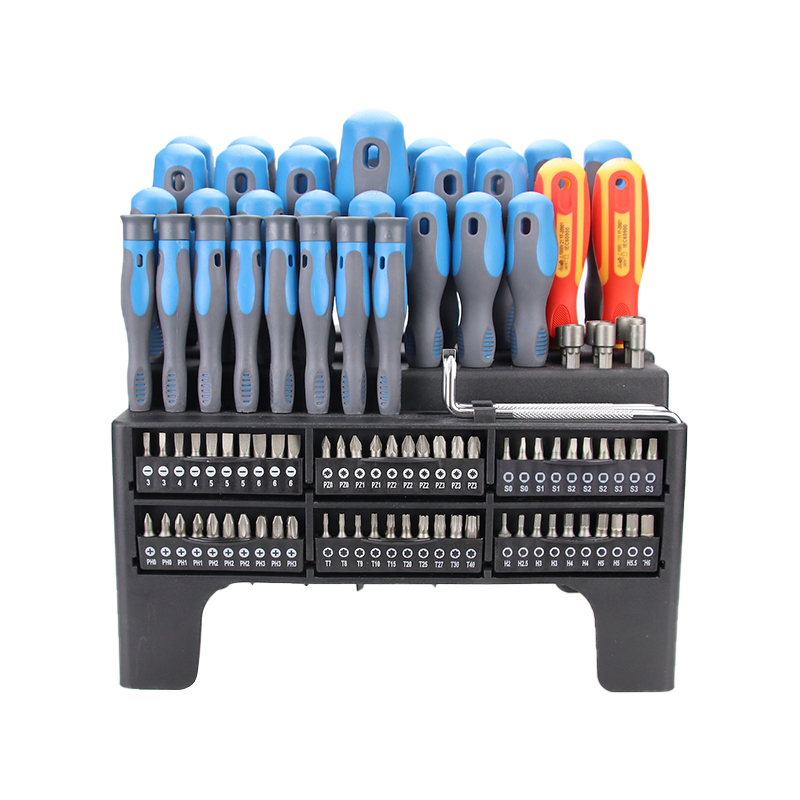
Most ratcheting screwdrivers accept interchangeable bits in a ¼-inch hex chuck, making them multi-drive tools compatible with Phillips, flathead, Torx, hex, and square bit sets. This versatility — combined with the speed advantage of ratchet action — makes the ratcheting screwdriver the standard tool for production assembly, appliance service, HVAC, and any task requiring driving large numbers of the same fastener. For electricians, HVAC technicians, IT rack installers, and furniture assemblers, a quality ratcheting driver with a full bit set replaces half a dozen individual fixed-blade screwdrivers.
Noteworthy variants include the inline ratcheting screwdriver (a straight, pencil-grip tool for tight access), the right-angle ratcheting screwdriver (for 90-degree access situations), and the offset ratcheting screwdriver (an L-shaped configuration that allows access in spaces where no straight driver can reach). Premium brands — Wera, Wiha, Klein Tools, and Snap-on — produce ratcheting screwdrivers with ergonomic handles designed for sustained use, superior ratchet mechanisms, and hardened chrome-vanadium internals that maintain their tolerances through years of professional use.
Can You Bring a Screwdriver on a Plane? TSA Rules Explained
Whether screwdrivers are allowed on planes is one of the most commonly searched TSA-related tool questions, and the answer depends entirely on the length of the screwdriver — not whether it is a flathead, Phillips, Torx, or any other type.
The TSA's official rule is straightforward: screwdrivers 7 inches or shorter (measured from the tip of the blade to the end of the handle) are permitted in carry-on baggage. Screwdrivers longer than 7 inches must go in checked baggage. This rule applies to all screwdriver types — standard handle drivers, ratcheting screwdrivers, precision electronics drivers — as long as the total length does not exceed 7 inches. Screwdriver bits alone (without a handle) are generally permitted in carry-on, as they do not constitute a tool on their own.
Practical implications of this rule:
- Precision electronics screwdriver sets — iFixit, Wiha, or similar compact kits — almost universally fall well under 7 inches and are straightforwardly permitted in carry-on. These are the screwdrivers most often carried by IT professionals, field engineers, and repair technicians who need to work on laptops or equipment at their destination.
- Standard full-size screwdrivers — a typical 10-inch Phillips or flathead — exceed 7 inches and must be checked. A compact 6-inch version of the same driver type would be permitted.
- Ratcheting screwdrivers vary by model. Compact ratcheting drivers designed for electronics and light work (Wera Kraftform Kompakt, Klein Tools 6-in-1) often fall under or near the 7-inch limit; full-size professional ratcheting drivers typically exceed it.
- Magnetic tip screwdrivers are subject to the same length rule and no separate restriction for the magnet — consumer-grade magnetic drivers are not strong enough to affect aircraft instruments.
It is worth noting that TSA rules govern US domestic and international departure security; other countries' security agencies (UK's DfT, EU's ECAC, Australian Border Force) have their own tool rules that may differ. The UK's rules, for example, are stricter: sharp or pointed tools including screwdrivers are generally not permitted in cabin baggage regardless of length under some UK carrier policies, though official DfT guidance aligns more closely with TSA length thresholds. Travelers on international itineraries should verify the rules of each country's departure security, not just the TSA standard.
The safest practical approach for travelers who regularly carry tools: measure your screwdrivers before packing, carry only those under 7 inches in the carry-on, and pack a compact multi-bit ratcheting driver set rather than multiple full-size drivers. A quality compact set — 6 inches overall, with a full Torx, Phillips, flathead, and hex bit selection — handles the majority of field service and electronics tasks while remaining unambiguously compliant with TSA carry-on rules on any itinerary.