

 English
 русский
 Español
How Are Screwdrivers Measured?
Screwdrivers are measured by two independent dimensions: blade length and tip size. Both matter, and confusing them is one of the most common reasons a screwdriver feels wrong for the job even when the drive type appears correct.
Blade Length
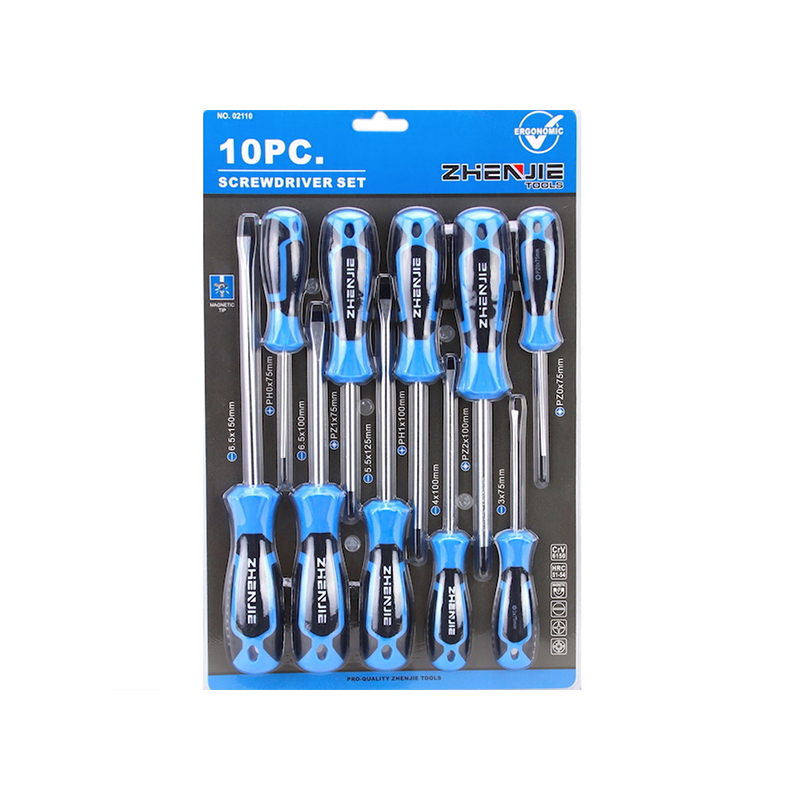
Blade length is measured from the base of the handle to the tip of the blade — not including the handle itself. Standard lengths range from 75 mm (3 in) for stubby drivers up to 300 mm (12 in) for long-reach models. The blade length determines reach and torque leverage: a longer blade gives more reach into deep recesses but reduces tactile control, while a shorter blade offers greater precision in tight spaces.
Tip Size
Tip size is a separate measurement entirely. For flat head (slotted) drivers, tip size refers to the blade width and thickness — for example, a 6 × 1.0 mm tip is 6 mm wide and 1.0 mm thick. For Phillips and Pozidriv drivers, tip size is expressed as a point number (PH0 through PH4), where higher numbers correspond to larger screw heads. A PH2 is by far the most common size used in general assembly work.
Handle diameter and shaft diameter are also occasionally specified, particularly for precision screwdrivers used in electronics where torque values must be controlled. In those contexts, a handle diameter of 20–30 mm is typical for comfort grip, and shaft diameters of 3–6 mm are standard for medium-duty applications.
Types of Phillips Head Screwdrivers
The Phillips drive system was patented in the 1930s and remains one of the most widely used fastener interfaces in manufacturing, electronics, and construction. Understanding the types of Phillips head screwdrivers — and the differences between the point sizes — prevents cam-out damage and stripped screw heads.
| Size | Screw Diameter Range | Typical Application |
|---|---|---|
| PH0 | #0–#1 (1.5–2.0 mm) | Eyeglass frames, miniature electronics |
| PH1 | #2–#4 (2.5–3.5 mm) | Small appliances, computer hardware |
| PH2 | #5–#9 (4.0–6.0 mm) | General construction, furniture, automotive |
| PH3 | #10–#16 (6.0–8.0 mm) | Heavy construction, lag bolts, structural work |
| PH4 | #18+ (8.0 mm+) | Industrial fastening, rarely encountered in field work |
Phillips vs Pozidriv: Many users confuse these two systems. Pozidriv (PZ) tips have a secondary set of ribs at 45° to the main cross, giving them more contact area and significantly reducing cam-out compared to standard Phillips. PZ2 and PH2 look similar at a glance but are not interchangeable without risking fastener damage. European-manufactured furniture and machinery typically use Pozidriv; North American products default to Phillips.
A stubby Phillips screwdriver (blade 25–40 mm) in PH2 is among the most practical tools in any kit for working in confined engine bays or panel interiors where a standard-length shaft cannot be positioned perpendicular to the screw. Ratcheting Phillips handles allow continuous driving without repositioning the hand, reducing fatigue on high-volume assembly tasks.
What Screwdrivers Can Be Safely Used For
Screwdrivers are designed for one primary task: driving and removing threaded fasteners. Used within that scope, they are among the safest hand tools on any job site. Problems arise when they are pressed into uses they were not engineered for.
Screwdrivers can be safely used to:
- Drive and extract slotted, Phillips, Pozidriv, Torx, and other compatible threaded fasteners
- Apply controlled rotational force to terminals, adjustment screws, and set screws within their rated torque
- Open paint can lids — using the handle end, not the tip, which protects the blade geometry
- Release spring clips in electronics (with a precision driver) when the blade width is a correct fit
- Perform electrical work — only when using a fully insulated VDE-rated driver tested to 1,000V AC
Tasks that seem feasible but should be avoided include using a screwdriver as a chisel (the handle is not designed for hammer impact and the blade may fracture), as a pry bar (bending the shaft compromises alignment permanently), or as a punch (which concentrates stress at a point the blade is not hardened to handle). These misuses account for a disproportionate share of hand tool injuries in professional workshop environments.
Flat Head Screwdriver Safety Tips
The flat head (slotted) screwdriver is statistically involved in more hand tool injuries than any other screwdriver type — not because it is inherently dangerous, but because its open tip and tendency to slip out of the slot make it less forgiving of poor technique. Following these safety practices reduces that risk significantly.
Match the Tip to the Slot
The blade width should fill the screw slot completely without overhanging the edges. A blade that is too narrow rocks in the slot and cams out under torque; one that is too wide bears on the surrounding material and damages the workpiece. The blade thickness should also match the slot depth — a thin blade in a deep slot will twist under heavy torque.
Control the Blade Direction
Never position any part of your body in the path of the blade in case the tip slips. Always secure the workpiece in a vise or clamp rather than holding it in your free hand. The slotted tip provides no anti-rotation geometry — all alignment depends on the operator maintaining downward pressure throughout the stroke.
Inspect and Maintain the Tip
A worn, rounded, or chipped flat head tip is a slip hazard. The tip edges should be flat and square — not tapered like a wedge. Some manufacturers grind their tips with a slight taper for visual appeal, but a parallel-ground tip provides superior slot engagement and requires less downward force to stay seated. Replace or regrind tips that have lost their flat profile.
Electrical Work: Insulation Is Non-Negotiable
Only use flat head screwdrivers with fully insulated blades and handles — marked with the VDE double-triangle symbol and rated to 1,000V AC / 1,500V DC — when working near live circuits. Standard rubber-grip handles provide no meaningful electrical insulation. The insulation must extend to within a few millimeters of the very tip; any exposed metal on the blade above the working end is a shock risk when operating in tight electrical enclosures.
Ferrous and Non-Ferrous Materials Used in Screwdrivers
The performance of a screwdriver depends heavily on the materials used for both the blade and the handle. Manufacturers work with a combination of ferrous and non-ferrous alloys, each selected for specific mechanical and safety properties.
Ferrous Materials (Iron-Based)
The blade and shaft of virtually every professional-grade screwdriver is made from a ferrous alloy. The most common choices are:
- Chrome vanadium steel (Cr-V): The industry standard for hand tool blades. Chromium adds corrosion resistance and hardenability; vanadium refines grain structure and improves toughness. Typical Cr-V blades are heat-treated to 50–60 HRC, giving them the hardness needed to resist tip deformation under torque without becoming brittle.
- Chrome molybdenum steel (Cr-Mo): Used in impact-rated drivers and heavy-duty professional tools. Molybdenum improves high-temperature strength and impact toughness, making Cr-Mo alloys better suited for power driver bits and tools used with impact wrenches.
- Stainless steel: Used in medical-grade and food-safe screwdrivers where corrosion resistance outweighs maximum hardness. Stainless blades are generally softer (40–50 HRC) than Cr-V and not suited for heavy-torque applications.
Non-Ferrous Materials
Non-ferrous materials are primarily used for handles and, in specialist tools, for shafts where magnetic neutrality or electrical non-conductivity is required:
- Cellulose acetate butyrate (CAB) and polypropylene (PP): The most common handle materials. These thermoplastics are impact-resistant, chemically resistant to oils and solvents, and provide good grip texture. CAB has a natural translucency that some manufacturers use to indicate the handle is non-insulated.
- Thermoplastic rubber (TPR) / Santoprene: Used for the outer grip layer in bi-material handles (hard core + soft grip). TPR provides vibration damping and improves wet-hand grip without adding significant bulk.
- Aluminum and titanium alloys: Occasionally used for precision screwdriver bodies in electronics work where low weight and non-magnetic properties matter. Titanium in particular is used in MRI-safe tool sets where ferrous metal is strictly excluded.
- Fiberglass-reinforced composites: Used for the shafts of VDE-insulated screwdrivers to eliminate conductivity while maintaining axial rigidity. A fiberglass shaft will not transmit current even if the insulating sheath is damaged.
The distinction between ferrous and non-ferrous materials becomes operationally critical in environments with strong magnetic fields, explosive atmospheres (where spark risk must be eliminated), and live electrical work — each requiring specific material selections beyond what standard commercial screwdrivers offer.