

 English
 русский
 Español
Screw Bits Types: The Complete Taxonomy
Screw bits types are more numerous than most people realize — the global fastener industry recognizes over 30 distinct drive systems, though the majority of professional and DIY work is covered by a core group of seven. Understanding the differences between them — their geometry, their intended application, and their limitations — prevents stripped fasteners, damaged workpieces, and wasted time selecting the wrong tool for a job.
Slotted (Flat Head)
The oldest drive type, consisting of a single straight slot across the screw head. Slotted drives are now used primarily in legacy electrical work (terminal screws, cover plate screws), decorative applications, and wood screws where appearance matters more than torque efficiency. The geometry actively encourages cam-out — the bit riding out of the slot under high torque — which is a design feature in applications where limiting overtightening is desirable, but a significant disadvantage in power tool use.
Phillips (#0 through #4)
The Phillips drive was patented in 1936 specifically to allow power screwdrivers to cam out at a predetermined torque, preventing overtightening on automotive assembly lines. The cross-shaped recess has tapered flanks that push the bit upward when torque exceeds the designed limit. Phillips remains the most widely produced screw drive system globally, dominant in consumer electronics, appliances, and general assembly. Available in five sizes — #0 (smallest) through #4 — with #1 and #2 covering the vast majority of applications.
Pozidriv (PZ0 through PZ4)
Developed as a direct improvement on Phillips, Pozidriv adds four additional radial ribs at 45° to the main cross flanks, creating eight contact points instead of four. The flanks are parallel (not tapered), eliminating intentional cam-out and allowing significantly higher torque transmission. Pozidriv and Phillips bits are not interchangeable despite their visual similarity — using a Phillips bit in a Pozidriv recess (or vice versa) causes rapid recess damage. Pozidriv is the dominant system in European furniture, construction, and cabinetry hardware.
Torx / Star Drive (T1 through T100)
Torx features a six-pointed star recess with straight (non-tapered) lobes that make full surface contact with the bit, distributing torque evenly across all six points rather than concentrating it at corners. This geometry virtually eliminates cam-out, allows very high torque transmission for a given recess size, and extends both bit and fastener recess life significantly compared to Phillips. Torx is now standard in automotive assembly, electronics, appliances, bicycles, and structural construction hardware. Tamper-resistant variants (Torx Plus, Security Torx with a center pin) are used in consumer electronics and public infrastructure to deter unauthorized disassembly.
Hex / Allen (H1.5 through H19)
Six-sided internal drive, used in socket head cap screws, grub screws (set screws), and furniture assembly hardware (flat-pack furniture bolts). Hex drive bits deliver excellent torque transmission and are available in both metric (millimeter) and imperial (inch) sizes. Ball-end hex bits allow angled engagement up to 25–30° from true alignment, useful in confined spaces. Hex drive is the standard in precision mechanical assembly, bicycle components, and machine building.
Square Drive / Robertson (#0 through #4)
Invented in Canada in 1908, the Robertson square drive provides excellent cam-out resistance and allows one-handed screw starting (the bit holds the screw magnetically in the recess). It remains dominant in Canadian construction and woodworking and is gaining adoption in North American decking and framing fasteners. The square geometry delivers high torque with minimal recess wear, and Robertson-compatible screws are increasingly specified for structural and exterior wood applications across North America.
TORX PLUS, Tri-Wing, Pentalobe, and Security Drives
Specialty and tamper-resistant screw bits types include Torx Plus (IP series, with rounded lobe tips for even higher torque), Tri-Wing (consumer electronics, particularly Nintendo products), and Pentalobe (Apple devices — iPhone, MacBook). These drives are designed specifically to require proprietary tools, limiting field repair. Specialized bit sets covering these drives are available from precision tool manufacturers and are essential for electronics repair professionals.
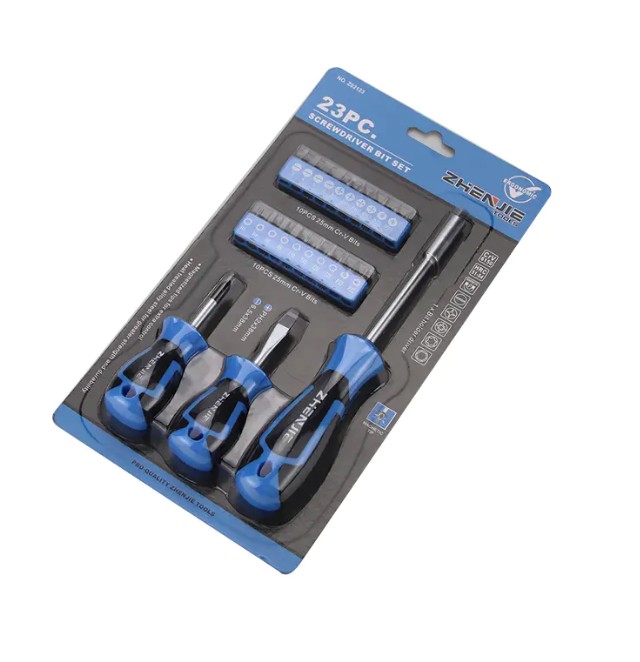
Screwdriver Bit Sizes Chart: Reading the Numbers
Screwdriver bit sizes are designated differently for each drive system, and cross-system confusion is one of the most common causes of fastener damage. The following reference covers the sizing conventions for the most widely used drive types and maps them to their typical screw size ranges:
| Drive Type | Size Designation | Typical Screw Size Range | Common Application |
|---|---|---|---|
| Phillips | #0, #1, #2, #3, #4 | #0: M1–M2 / #1: M2–M3.5 / #2: M4–M8 / #3: M8–M12 | #2 handles ~80% of all Phillips fasteners encountered |
| Pozidriv | PZ0, PZ1, PZ2, PZ3, PZ4 | PZ1: M2.5–M3.5 / PZ2: M4–M6 / PZ3: M8–M10 | European furniture hardware, construction screws |
| Torx | T1–T100 (point-to-point diameter) | T6–T8: M2–M2.5 / T10–T15: M3–M4 / T20–T25: M5–M6 / T27–T40: M6–M10 | Automotive, appliances, structural hardware |
| Hex / Allen | Metric: 1.5mm–19mm / Imperial: 1/16"–3/4" | 2mm: M3–M4 / 4mm: M6–M8 / 6mm: M10–M12 / 8mm: M14–M16 | Socket head cap screws, grub screws, bike components |
| Robertson / Square | #0 (orange), #1 (yellow), #2 (red), #3 (black), #4 (green) | #1: #4–#6 screw / #2: #7–#10 screw / #3: #10–#14 screw | Wood screws, decking, framing (North America) |
| Slotted | Blade width in mm (2.5mm–14mm) | 3mm blade: M2.5–M4 / 5.5mm: M5–M8 / 8mm: M10–M12 | Terminal screws, legacy electrical, decorative hardware |
One point the screwdriver bit sizes chart above makes clear: no single size within any drive type covers all fasteners, and the most damaging mistake in fastener work is using the closest-fitting wrong size rather than the exactly correct one. A T25 bit in a T27 Torx recess, or a PH2 bit in a PZ2 Pozidriv, will engage partially but damage the recess on the first high-torque application. Always match bit to fastener exactly, and when in doubt, measure the recess with a bit gauge before driving.
Phillips Screwdriver Uses: Where It Excels and Where It Fails
Phillips screwdriver uses span virtually every industry and application category, making the #2 Phillips bit the single most-reached-for tool in both professional and domestic settings. Understanding where Phillips drive performs well — and critically, where it does not — prevents the frustration of stripped recesses and damaged fasteners that give Phillips an undeserved reputation for poor performance.
Where Phillips Performs Well
Phillips drive was engineered for medium-torque, high-speed power tool assembly where self-limiting cam-out prevents overtightening on production lines. It performs excellently in: consumer electronics assembly (circuit board standoffs, case screws), appliance manufacturing, general hardware (hinges, door hardware, cabinet fittings), light woodworking (trim screws, cabinetry), and drywall installation with proper Phillips drywall bits. In all these applications, the combination of widespread availability, moderate torque requirement, and self-limiting behavior makes Phillips the appropriate and efficient choice.
Where Phillips Fails — and What to Use Instead
Phillips drive is poorly suited to applications requiring high torque, rusted or seized fasteners, or repeated removal and reinstallation cycles. The cam-out geometry that limits overtightening in production contexts becomes a liability when high torque is needed to break loose a corroded screw — the bit rides out before the fastener moves, enlarging the recess with each attempt. Specific contexts where Phillips screwdriver uses should be avoided in favor of alternatives:
- Automotive fasteners: Torx has replaced Phillips in most automotive assembly globally because higher torque is required and recess longevity over the vehicle's service life matters. Using a Phillips bit on Torx automotive fasteners — or on seized Phillips screws in engine bays — is the most common cause of stripped automotive fastener recesses.
- Structural and outdoor wood fasteners: Deck screws, structural screws, and exterior wood hardware are now predominantly Robertson or Torx drive precisely because Phillips cam-out under high driving torque causes recess failure before the screw reaches full seating depth.
- European furniture hardware: What appears to be a Phillips recess in European flatpack furniture is almost always Pozidriv. Using a Phillips bit strips the recess within two or three tightening cycles; PZ2 is the correct tool for the majority of European furniture assembly screws.
The single most effective practice for maximizing Phillips screwdriver uses without stripped recesses is maintaining axial pressure on the bit throughout the driving stroke — keeping the bit pressed firmly into the recess prevents the cam-out geometry from engaging until the fastener is fully seated.
T40 Torx Screwdriver: Specifications and Applications
The T40 Torx screwdriver — or T40 Torx bit — sits in the upper-medium range of the Torx size series, with a point-to-point recess diameter of 7.93 mm and a nominal drive engagement depth that suits M8 to M10 metric fasteners in most standard head configurations. It is one of the larger Torx sizes commonly encountered outside of heavy industrial contexts, and its applications reflect the higher torque requirements of the fasteners it drives.
Primary T40 Torx Applications
The T40 is encountered most frequently in the following contexts:
- Automotive chassis and suspension components: Brake caliper mounting bolts, suspension arm fasteners, and subframe bolts in European vehicles (particularly Volkswagen Group, BMW, Mercedes-Benz, and Volvo) commonly use T40 Torx. These fasteners are torqued to 30–60 Nm in many applications, well within the T40's torque capacity but demanding correct tool engagement to prevent recess rounding.
- Heavy machinery and agricultural equipment: Implement attachment points, gearbox covers, and hydraulic component mounting brackets on tractors and construction equipment increasingly use T40 Torx in place of hex head fasteners where tool access is restricted.
- Industrial equipment panels and enclosures: Control cabinet hinges, industrial machine guards, and access panel fasteners often specify T40 Torx to deter casual unauthorized access while not requiring specialized security tools.
- Large appliance assembly: Washing machine drums, dishwasher inner baskets, and refrigerator compressor mounting use T40 fasteners in structural positions where tamper resistance and high torque retention are required.
T40 Tool Formats and Selection
T40 Torx tools are available in three primary formats: 1/4-inch hex shank bits (for use in power drivers and bit holders, standard 25 mm or 50 mm length), 3/8-inch or 1/2-inch square drive socket adaptors (for torque wrench applications where fastener torque must be controlled), and dedicated T40 Torx screwdrivers with fixed handles for manual applications. For automotive suspension and chassis work where torque specifications must be followed precisely, the socket adaptor format used with a calibrated torque wrench is the correct tool — not a power driver, which cannot reliably deliver and stop at a specified torque without a clutch-limited attachment.
Torque Bit Screws: What They Are and Why Torque Control Matters
"Torque bit screws" refers to two distinct but related concepts that are frequently conflated: screws designed for use with torque-limiting bit systems, and torque-indicating or torque-limiting bits themselves. Understanding both is essential for applications where precise torque application determines structural integrity, seal quality, or product longevity.
Torque-Sensitive Screw Applications
Certain fastener applications have narrow torque windows where both undertightening and overtightening cause failure. These include: electrical terminal screws (undertorque causes resistance and heat; overtorque cracks terminals or strips threads), plastic housing assembly screws (overtorque strips molded bosses; undertorque allows cover separation), medical device assembly (ISO 13485 quality requirements mandate torque verification), and aerospace and structural fasteners (AS9100 and aircraft maintenance manuals specify torque to within ±10% of nominal). In all these applications, the bit system must either limit torque automatically or allow torque measurement during driving.
Torque-Limiting Bit Attachments
Torque-limiting bit holders use a calibrated slip clutch mechanism in the holder body to disengage drive transmission at a preset torque value. The bit continues to rotate in the holder once the set torque is reached, preventing additional torque from being applied regardless of how much force the operator or power tool applies. Preset torque-limiting holders are available in ranges from 0.1 Nm to 30 Nm and are used extensively in electronics assembly, medical device manufacturing, and automotive interior trim installation. Adjustable versions allow a single holder to cover a torque range, though preset holders provide better repeatability for production line use.
Drive Bit Material and Torque Capacity
The torque capacity of a screwdriver bit is determined by its material, heat treatment, and cross-sectional geometry. Standard S2 tool steel bits — the most common grade in commercial bit sets — provide adequate torque capacity for most applications but are brittle at the high hardness levels required for wear resistance. Impact-rated bits use a torsion zone — a reduced-diameter section machined into the bit shank — that absorbs peak torque spikes from impact drivers by flexing elastically rather than fracturing. Using standard S2 bits in impact drivers causes premature bit breakage at the shank-to-tip transition; always use impact-rated bits (typically identified by black oxide finish and "impact" designation) in impact driver applications.
Long Screwdriver Bit Set: When Length Matters and How to Choose
A long screwdriver bit set addresses one of the most common practical limitations in fastener work: reaching screws in recessed, deep, or obstructed locations that standard 25 mm bits cannot access. Understanding the different length categories, their specific use cases, and the trade-offs in torque transmission and bit stability at extended lengths allows informed selection for both professional and workshop applications.
Bit Length Categories and Their Applications
Screwdriver bits are produced in standardized length categories, each optimized for a distinct class of application:
- Standard bits (25 mm / 1 inch): The universal format for bit holder and power driver use. Optimal for surface-accessible fasteners and general-purpose work. The vast majority of bit sets are built around this length.
- Long bits (50 mm / 2 inch and 75 mm / 3 inch): The most common upgrade for construction, cabinet installation, and furniture assembly work where screws are set 30–60 mm below the work surface. A 50 mm PH2 or PZ2 bit is the standard tool for drywall screw installation and cabinetry work, allowing the driver nose to clear the work surface while the bit engages the fastener.
- Extra-long bits (100 mm / 4 inch and 150 mm / 6 inch): Used in electrical panel installation (reaching terminal screws inside enclosures), HVAC ductwork fastening, structural framing screw work, and automotive applications where components must be reached past obstructions. Require a bit holder with magnetic retention to prevent the bit dropping into inaccessible cavities.
- Extended reach bits (200 mm / 8 inch and above): Specialty lengths for deep cavity work — reaching screws inside appliance housings, boat bilge hardware, or structural fasteners inside wall cavities through access holes. At these lengths, bit wobble and alignment become significant practical issues; use a bit holder with a guide nose or magnetic screw-holding attachment to maintain alignment.
What to Look for in a Long Screwdriver Bit Set
A professional-grade long screwdriver bit set should cover the most commonly needed drive types and sizes in extended lengths, rather than simply including a large quantity of low-utility sizes. The highest-value configuration for a generalist long bit set includes: PH1 and PH2 Phillips in 50 mm and 100 mm; PZ1 and PZ2 Pozidriv in 50 mm and 75 mm; T10, T15, T20, T25, T27, and T30 Torx in 50 mm; H3, H4, H5, and H6 hex in 75 mm; and a SQ2 Robertson in 50 mm and 75 mm. Impact-rated steel construction is essential for long bits used in power drivers — the leverage effect of an extended bit amplifies torsional stress at the shank, and standard S2 bits fracture at this point far more readily than in standard-length configurations.
Flexible Shaft Extensions vs. Long Bits
For fasteners in truly inaccessible locations — around corners, inside deep housings, or in angular approaches — a flexible shaft extension (typically 150–300 mm of flexible stainless steel shaft with 1/4-inch hex fittings at both ends) accepts standard 25 mm bits and allows fastener engagement at angles up to 90° from the driver axis. Flexible extensions reduce torque transmission efficiency and are unsuitable for high-torque applications, but for low-torque fasteners in genuinely awkward access situations they outperform even the longest rigid bit set. A comprehensive professional toolkit includes both a long screwdriver bit set and one or two flexible extensions as complementary tools for different access challenges.