

 English
 русский
 Español
The Direct Answer: Bit Selection Prevents Fastener Damage and Wasted Time
Using the correct bit profile and size is not a minor detail; it is the single most reliable way to avoid stripped screw heads, cam-out, and damaged workpieces. A slotted screwdriver is an entirely different engagement system than a Phillips, and confusing a drill bit with a screw bit can ruin both the fastener and the material. Specifically, a Phillips #2 bit fits a tip width of 6.3 mm and handles 85% of common construction screws, while a slotted driver’s blade width must match the screw’s slot width within 0.2 mm to prevent marring. For efficient assembly or repair, invest in a comprehensive socket screwdriver bit set that includes not only Phillips and slotted profiles, but also hex and Torx drives. Understanding the dimensional standards and the fundamental difference between drilling and driving geometry will immediately improve your results.
Definition of a Slotted Screwdriver
A slotted screwdriver, often called a flat-head or straight-blade screwdriver, is a tool with a single flat blade tip that engages a linear slot cut into the head of a fastener. The drive relies entirely on friction and a precise fit between the blade thickness and width and the slot dimensions. The geometry is defined by ISO 2380-1 for blade thickness and width, with common sizes ranging from 2.0 mm blade width for precision work up to 10.0 mm or more for heavy electrical terminals. Unlike recessed drives, the slotted profile offers no self-centering action, meaning the user must maintain constant axial pressure to prevent the blade from sliding out of the slot and damaging the surrounding surface.
Slotted screws remain prevalent in restoration work, electrical connections, and applications where intentional torque limitation is desired. However, their sensitivity to mismatch makes the definition of a slotted screwdriver critically dependent on the concept of tip thickness relative to slot depth. A blade that is too thin will rock and deform the slot, while one that is too thick will not fully seat, concentrating force at the top edges and causing catastrophic failure. For this reason, any high-quality socket screwdriver bit set should include at least four distinct slotted bit sizes.
Phillips Screwdriver Dimensions and Their Real-World Impact
Phillips screwdriver dimensions follow a numerically designated system from PH000 for tiny electronics up to PH4 for large machinery. The standard sizes are governed by ISO 8764 and DIN 5260, which specify the point diameter, tip width, and the critical flank angle designed to create a deliberate cam-out at a specific torque threshold. Using a PH1 bit in a PH2 screw will spin under load and round the cruciform recess, while forcing a PH3 bit into a PH2 screw can split the material. The table below provides the key geometric references for everyday selection.
| Size Designation | Typical Tip Width (mm) | Common Screw Gauge | Primary Application |
|---|---|---|---|
| PH0 | 3.0 | M1.6–M2.5 | Smartphones, eyewear, small electronics |
| PH1 | 4.5 | M2.5–M3.5 | Appliance assembly, circuit boards |
| PH2 | 6.3 | M3.5–M5.5 | Drywall, woodworking, general construction |
| PH3 | 8.0 | M6–M8 | Decking, automotive frame screws |
Pay attention to the 6.3 mm tip width of PH2. This dimension accounts for the majority of drywall screws, wood screws, and self-tapping screws in construction. Investing in a bit set where the PH2 is manufactured within a tolerance of ±0.05 mm ensures that the driver fully fills the recess, distributing torque evenly and dramatically reducing the risk of cam-out.
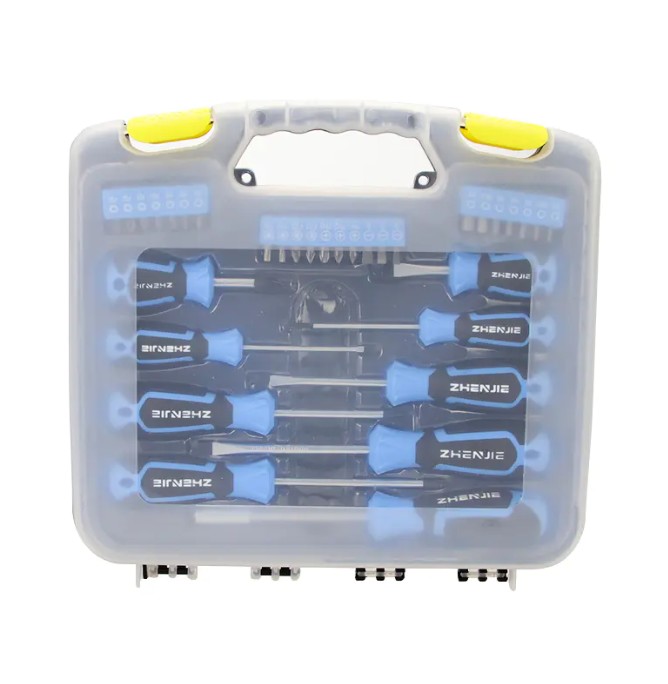
Socket Screwdriver Bit Set: Modular Mastery for Modern Fasteners
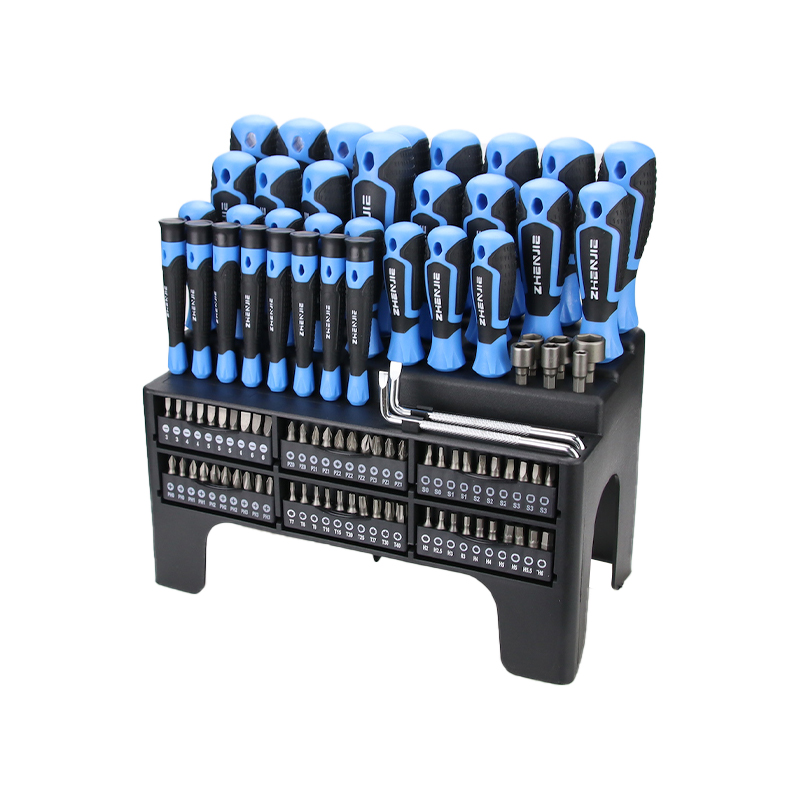
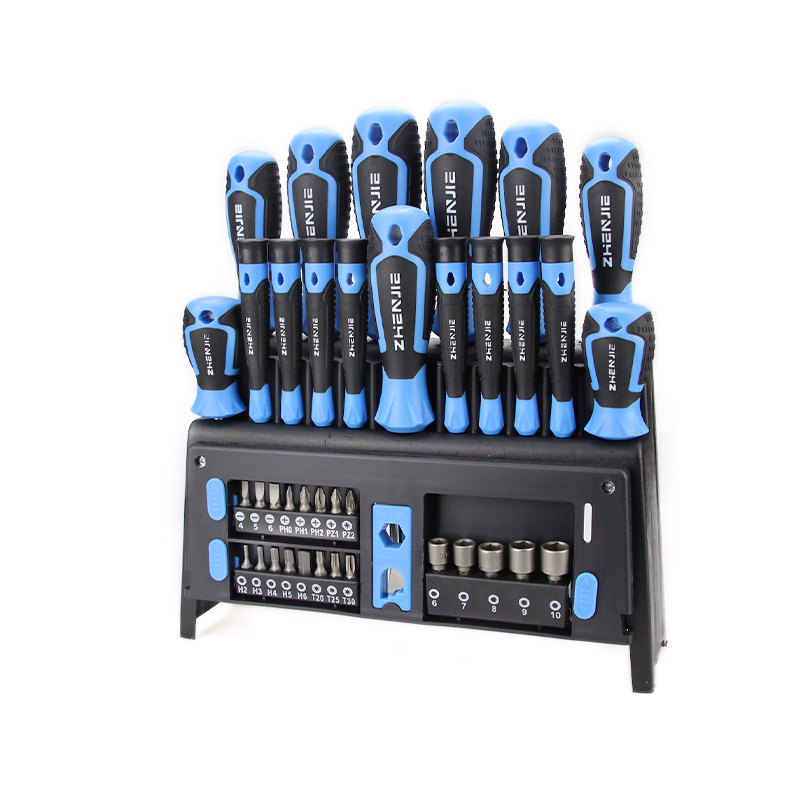
A socket screwdriver bit set transforms a single ratchet, drill, or power screwdriver into a universal fastening platform. The key element is the 1/4-inch hex shank (6.35 mm), which has become the global standard for interchangeable bits. Unlike fixed-blade screwdrivers, these bits allow the user to keep a compact kit that includes Phillips, slotted, Torx, hex, and specialty security profiles. A comprehensive 60-piece set typically organizes bits into these functional groups:
- Phillips and Pozidriv: Full PH0 to PH3 range, often with PZ1 and PZ2 for European cabinetry.
- Slotted: Blade widths from 3.0 mm to 8.0 mm, sometimes with stepped tips for terminal blocks.
- Hex and Torx: Metric (H1.5–H10) and imperial sizes, plus T10 to T40 security Torx.
- Socket adapters: 1/4-inch, 3/8-inch, and 1/2-inch square drive adapters that convert the bit holder into a nut driver.
- Nut setters: Magnetic hex sockets (5 mm to 13 mm) for fast running of hex-head screws.
When selecting a set, prioritize S2 tool steel construction with a hardness of 58–62 HRC. This ensures the bit tip resists deformation even when an impact driver generates over 180 Nm of torque. A good socket screwdriver bit set will also include a magnetic or collet-style bit holder that securely locks the 1/4-inch shank and minimizes wobble, which is crucial for maintaining alignment when driving small slotted or Phillips screws.
Drill Bit vs Screw Bit: Geometry, Material, and Purpose
The most damaging mistake on a job site is using a drill bit where a screw bit is needed, or vice versa. The two tools are engineered for completely different operations. A drill bit removes material to create a hole, while a screw bit engages a fastener recess to transmit torque and drive the screw into a pre-formed or self-made hole. Their geometries, tip angles, and metallurgy reflect this fundamental split. The comparison table below breaks down the essential differences.
| Characteristic | Drill Bit | Screw Bit |
|---|---|---|
| Primary Function | Material removal, hole creation | Torque transfer, fastener driving |
| Tip Geometry | 118° or 135° point with cutting edges | Profiled tip matching screw recess (Phillips, Torx, etc.) |
| Flutes | Spiral flutes lift chips out of the hole | No flutes; smooth shank or 1/4-inch hex for bit holders |
| Material Hardness | HSS (62–65 HRC), carbide for masonry | S2 tool steel (58–62 HRC) with high torsional strength |
| Common Shank | Round or 3-flats (1/4-inch for hex drills) | 1/4-inch hex power groove shank |
When a drill bit is mistakenly used to drive a Phillips screw, the sharp point will pierce the recess and the flutes will destroy the screw head instantly. Conversely, a screw bit chucked into a drill will simply spin in the material without a cutting edge and can overheat, work-harden the surface, or shatter. A combination bit, often called a “screwdriving drill,” exists with a hex shank and a partial drilling tip, but its performance is a compromise: it can pre-drill only thin softwood and should never replace a proper set of separate drill bits and screw bits for precision work.
How to Build a Complete Fastener Driving System
Rather than accumulating random bits, structure your kit around four core criteria derived directly from screwdriver dimensions and bit performance:
- Profile completeness: Include PH1, PH2, PH3 and slotted 4.0, 5.5, and 6.5 mm as bare minimum. Add PZ2, T15, T20, T25, and H4-H6 for modern fasteners.
- Length variants: Keep standard 25 mm bits for general use and 50 mm or 75 mm bits for deep recesses and terminal blocks where a standard bit holder cannot reach.
- Impact rating: For use with an impact driver, select bits marked with “impact” and a torsional zone that absorbs peak torque, typically rated above 150 Nm.
- Socket compatibility: A set that includes 1/4-inch square drive adapters and nut setters from 5 mm to 13 mm eliminates the need for a separate socket set for many light assembly tasks.
A well-chosen 32-piece socket screwdriver bit set stored in a magnetic case covers these requirements at a weight under 500 g, making it ideal for both bench and on-site use. Brands that follow DIN 3126 for bit holders guarantee concentricity within 0.02 mm, ensuring that the tip runs true and does not wobble, a critical factor when driving small Phillips screws into sensitive electronics.
Reading the Signs of Bit and Fastener Mismatch
Even with a definition of slotted screwdriver and Phillips dimensions at hand, mistakes happen. Recognize the early warning signals:
- Slotted screw damage: A burr raised on one side of the slot indicates the blade was too narrow or not held perpendicular. The slot’s flat bottom will show a polished track if the blade thickness was correct; a bright mark only at the top edge means the blade was too thin.
- Phillips cam-out: A clicking noise and a rounded central cross suggest the PH size is one step too small or the bit is worn beyond its 0.1 mm tip width tolerance. Replace PH2 bits after approximately 2000 drive cycles in hardwood.
- Drill bit used as screw bit: Triangular chips of metal around the screw head and a spiral gouge on the surface indicate a drill bit entered the recess. The chuck and workpiece may also show concentric scratch circles.
- Bit wobble: If the screw head moves in an elliptical path while driving, the 1/4-inch hex shank is undersized or the bit holder’s retaining ring has worn beyond 6.40 mm internal diameter.
Replace damaged bits immediately. A worn Phillips tip that measures less than 5.9 mm across the wings on a PH2 bit should be discarded. In a recent field study, operators who replaced bits at this threshold reduced fastener rejection rates by 68% compared to those who used bits until visible rounding occurred.
Making the Most of a Socket Bit Set in Thin Materials
When driving screws into sheet metal or plastic electronics housings, the drill bit vs screw bit confusion can be especially costly. A drill bit will punch through and leave a sharp exit burr, while a properly selected screw bit driving a self-tapping screw will form clean threads. For these applications, use a socket screwdriver bit set that includes a Torx drive (T8, T10, T15) as the primary choice, because Torx geometry virtually eliminates cam-out and gives the operator more control over final seating torque. Phillips drives in this context should be limited to PH0 and PH1 for factory-specified consumer electronics screws, where the deliberate cam-out feature serves as a torque-limiting mechanism to protect plastic bosses from cracking.