

 English
 русский
 Español
The Irreplaceable Safety Role of an Insulated Screwdriver Set in Live Electrical Work
An insulated screwdriver set is the last physical barrier between an electrician and a potentially fatal electric shock when working on or near live equipment. Each screwdriver is designed and tested to protect the user at rated working voltages up to 1000V AC or 1500V DC, provided the tool is used correctly and remains undamaged. The insulation layer on the blade and handle isolates the conductive metal core, preventing current from reaching the user even if the tool shaft inadvertently contacts an energized conductor.
The practical necessity becomes clear when looking at workplace injury data. Electrical accidents account for roughly 4–5% of all occupational fatalities in industrialized countries annually, and a significant portion of non-fatal arc flash incidents are triggered by uninsulated tools shorting across terminals. Using a certified insulated screwdriver set reduces the risk of these incidents to near zero for low-energy circuits. For this reason, regulations such as NFPA 70E in North America and international safety standards now mandate the use of insulated tools whenever an electrician is working within the restricted approach boundary of exposed energized parts.
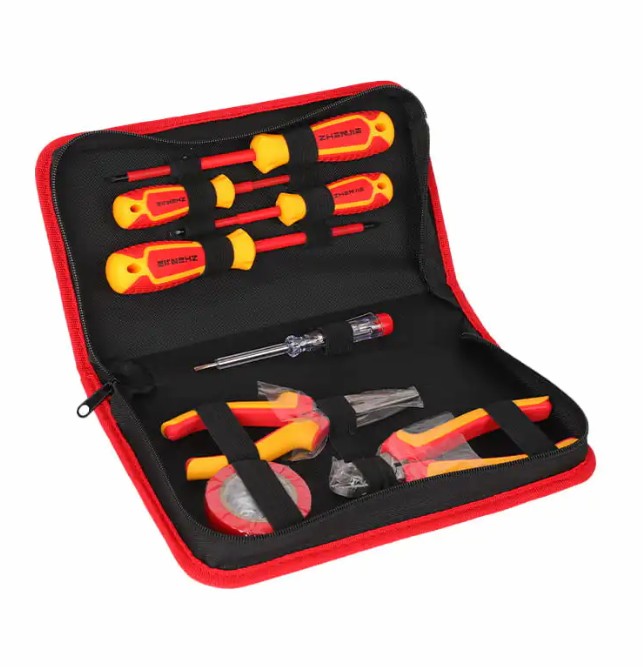
What VDE and IEC 60900 Certification Means for Your Insulated Screwdriver Set
Not every screwdriver with a plastic handle is insulated for live work. Genuine protection comes only from tools that have been independently tested to the IEC 60900 standard, which is often indicated by a VDE mark, the GS mark, or a specific certification body logo. The standard imposes rigorous requirements that go far beyond simple plastic coating.
| Test Requirement | Value Specified in IEC 60900 | What It Proves |
|---|---|---|
| Dielectric strength test | 10,000V AC applied for 3 minutes | Insulation withstands voltage far beyond the 1000V rating |
| Leakage current limit | Must not exceed 0.5 mA at 1000V | Safe current flow is blocked to physiological levels |
| Adhesion of insulation | No penetration by a 50N force applied for 10 seconds | Insulation layer will not slide or detach during use |
| Impact strength at low temperature | Survives impact at -25°C without cracking | Insulation stays intact in cold outdoor conditions |
The most critical detail is the voltage test. The 10,000V dielectric test guarantees that even if the tool has micro-damage or manufacturing variance, there is a massive safety margin above the rated working voltage. Additionally, the standard demands that the insulating material extend from the handle to within a few millimeters of the tip, leaving only the very end exposed. Any set that lacks a visible twin-color insulation layer — usually a red-orange outer jacket over a contrasting inner layer — does not meet the standard, because that dual-layer design provides a wear-through warning.
Typical Composition of a Professional Insulated Screwdriver Set
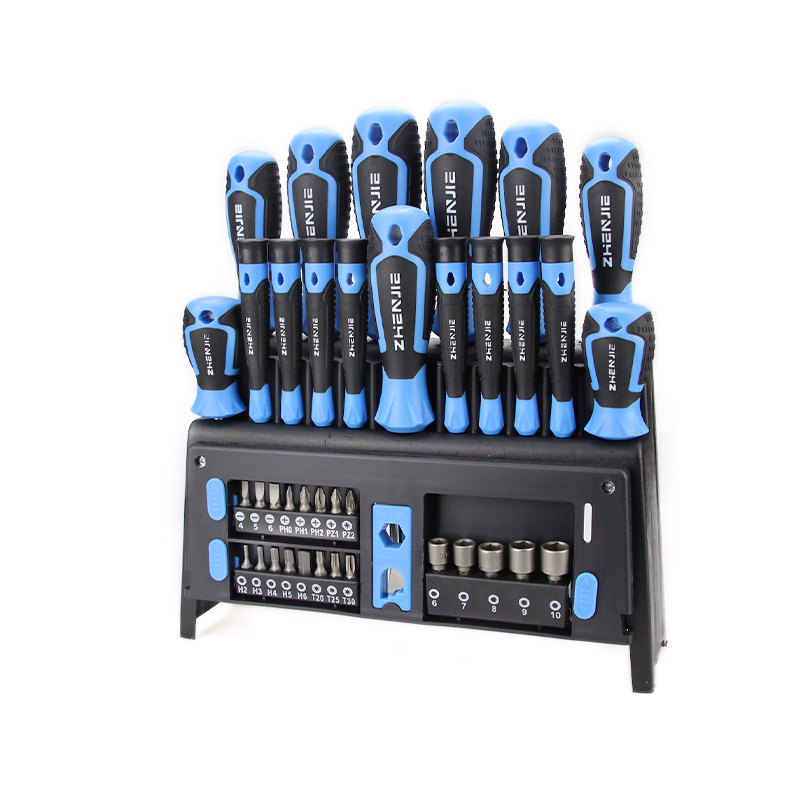
A well-equipped insulated screwdriver set is built around the drive types and sizes that electricians encounter in switchboards, control panels, circuit breakers, and terminal blocks. While sets range from compact 5-piece kits to comprehensive 18-piece assortments, the following table represents the core tools found in most professional kits.
| Drive Type | Common Sizes in Set | Primary Use |
|---|---|---|
| Slotted (flathead) | 2.5, 3.5, 4.0, 5.5, 6.5 mm | Terminal blocks, older switchgear, general prying |
| Phillips | PH0, PH1, PH2 | Panel screws, appliance terminals, control wiring |
| Pozidriv | PZ1, PZ2 | European circuit breakers, switch contacts |
| Torx | T10, T15, T20, T25 | Modern electronics, frequency drives, sensors |
Beyond the basic drive types, some professional insulated screwdriver sets include voltage testers integrated into the handle, non-conductive nut drivers for switchgear bolting, or slim insulation variants that fit deeply recessed terminals without exposing bare metal. The blade length is equally important: a typical set will feature shaft lengths from 80 mm for precision work to over 200 mm for access to deep terminal boxes.
Material and Design Factors That Separate an Everyday Insulated Screwdriver Set from a Premium One
While all VDE-certified tools meet the same minimum safety standard, significant differences in ergonomics, blade durability, and insulation robustness exist between budget and professional sets. The following elements directly impact daily reliability and long-term safety.
- Insulation layer composition and thickness: Premium tools use a double-layer insulation with a chemically bonded inner core, typically at least 0.3 mm thick per layer, to ensure that even if the outer color layer is cut, the contrasting inner layer remains intact as a visible warning.
- Blade steel and tip hardening: High-end sets use chrome-molybdenum or chrome-vanadium steel with a hardness of 58–62 HRC at the tip, induction-hardened to resist rounding under high torque. The tip tolerance is typically within ±0.02 mm to match fastener recesses perfectly.
- Handle ergonomics and grip: A multi-component handle with a soft, slip-resistant grip zone and a hard core reduces hand fatigue during repetitive work. The handle diameter should be at least 25–30 mm for optimal torque transfer, and the transition from insulation to exposed tip must be smooth to avoid catching on fingers.
- Corrosion resistance: Exposed metal tips on insulated screwdrivers are typically black-oxide finished or nickel-chrome plated to prevent rust, which could compromise the tip shape and create a conductive path if mixed with moisture.
The Inspection Routine That Keeps an Insulated Screwdriver Set Safe Over Its Lifetime
Certification alone does not guarantee safety if the tool is damaged. Even a hairline crack in the insulation can become a lethal conduction path under voltage. A consistent pre-use inspection habit is the only reliable defense against this risk.
- Visual check under good light: Roll each screwdriver and examine the entire insulation length for cuts, cracks, pin-holes, or swelling. Any visible damage that exposes the inner layer or metal core means the tool must be removed from service immediately.
- Tactile inspection: Run a gloved thumb along the insulation. If you feel a nick or if the outer layer feels soft, sticky, or has absorbed oil, the chemical resistance of the PVC may be compromised. Solvent and oil exposure is a leading cause of premature insulation degradation.
- Dielectric retest interval: Although no universal law requires annual testing, many safety programs follow the recommendation to electrically retest insulated tools every 6 to 12 months using a dedicated tester at 5,000–10,000V. Failure rates in field-used sets can be as high as 2–3% per year, driven primarily by undetected mechanical damage.
- Clean and store correctly: Insulation should be wiped clean with a damp cloth only, avoiding any abrasive or solvent-based cleaners. Store the set in a dedicated case, away from sharp tools that could puncture the insulation, and in a dry environment to prevent moisture buildup on the exposed tips.
A practical rule is to replace any insulated screwdriver that has been dropped from a height onto a hard floor, even if no external damage is apparent. Micro-cracks can propagate under mechanical stress and suddenly flash over when the tool is next used on a live circuit. The cost of replacing a single screwdriver is negligible compared to the potential consequences of an insulation failure.