

 English
 русский
 Español
A snapped bit costs more than the tool. A worn bit that rounds off a Phillips head can stop a production line or turn a five-minute repair into half an hour with a screw extractor. For anyone sourcing screwdriver bit sets in bulk, the first material decision is usually CRV vs S2 steel, because the choice shifts cost, edge life, return rates, and customer complaints. At JianDe ZhenJie Hardware Tools Co., Ltd., a screwdriver and bit set manufacturer in Zhejiang, we have run both materials through production lines and export sets to more than 30 countries.
Core definitions. CRV, or chromium-vanadium steel, is a low-alloy steel that balances strength, ductility, and corrosion resistance. S2 is a shock-resistant tool steel, often hardened to 58-62 HRC, made for drill bits and screwdriver bits that see repeated impact and high torque.
CRV Steel Basics: Toughness First
CRV is the safer choice when impact toughness and corrosion resistance matter more than ultimate hardness.
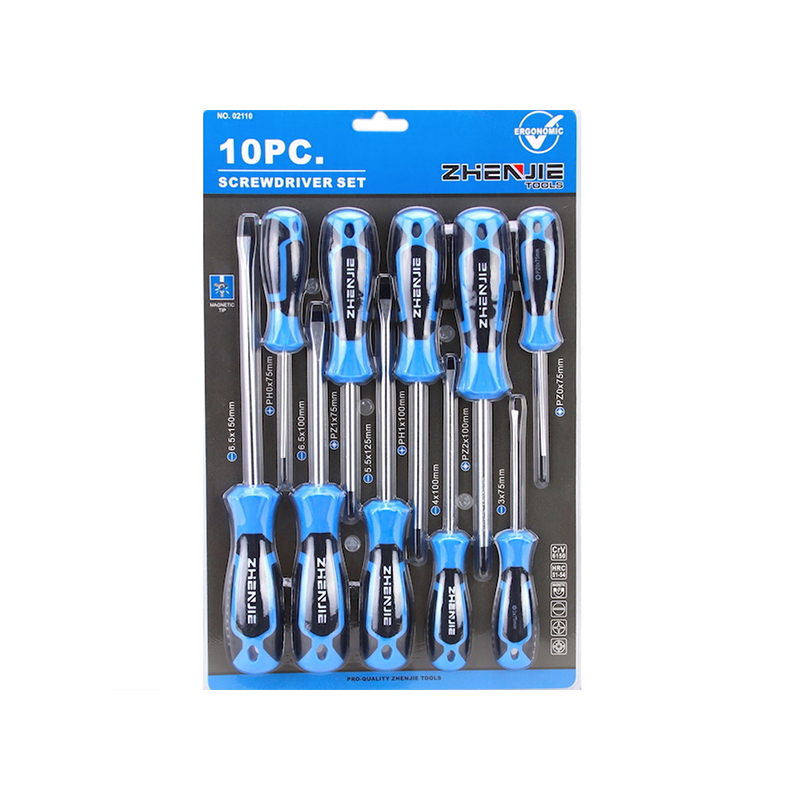
Typical CRV bit bodies run at 46-52 HRC after heat treatment. That is lower than S2, but the alloy's vanadium content refines grain structure and helps the bit bend under overload instead of snapping cleanly. This is why CRV remains the default steel for hand screwdrivers and multi-piece household sets.
- Chipping resistance: CRV takes moderate torque peaks without edge breakage.
- Corrosion resistance: chromium in the alloy forms a protective oxide layer, important for humid storage.
- Cost control: CRV billets and machining costs are lower, which directly lowers wholesale set prices.
- Magnetic tip behavior: CRV responds well to magnetization, a common requirement for bit holders and screwdriver sets.
In a manual screwdriver test on mixed wood screws and machine screws, a 48-HRC CRV bit typically fails by wear or mild bending. An S2 bit at 60 HRC can fail by chipping if the bit hits a hard edge at an angle. That difference changes return rates in retail channels.
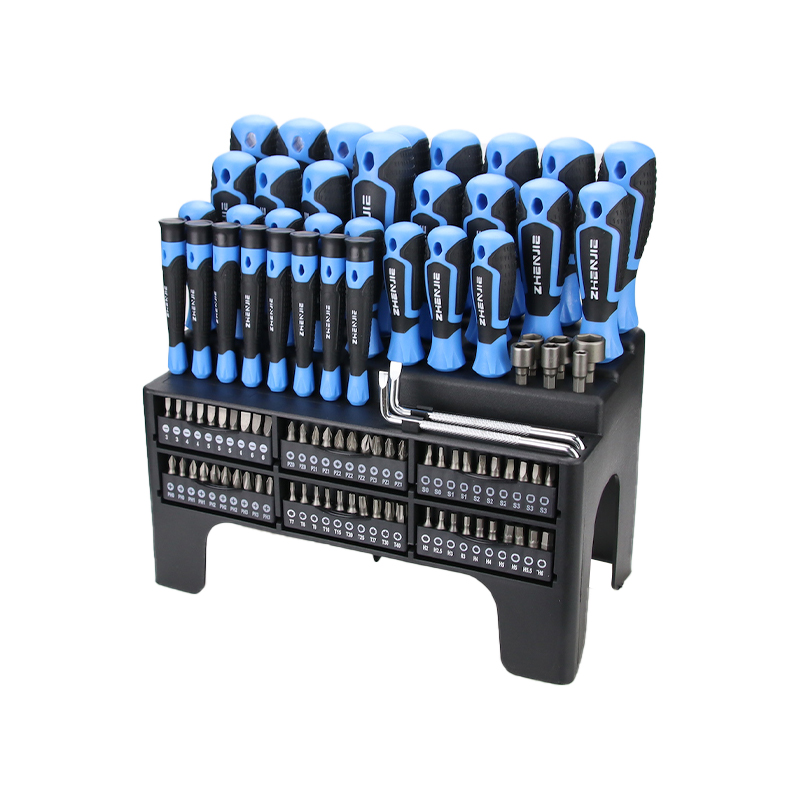
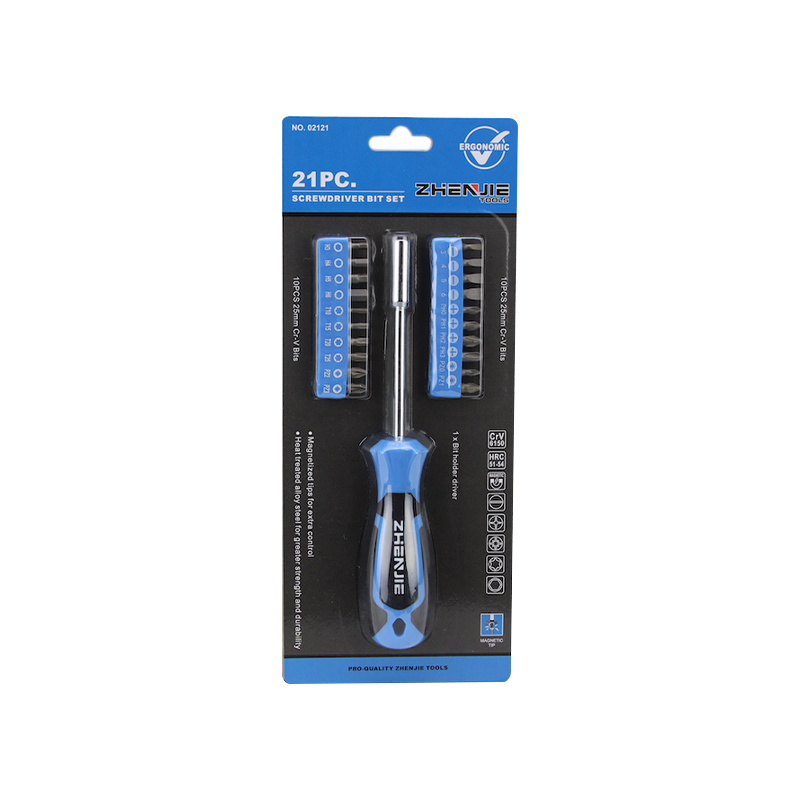
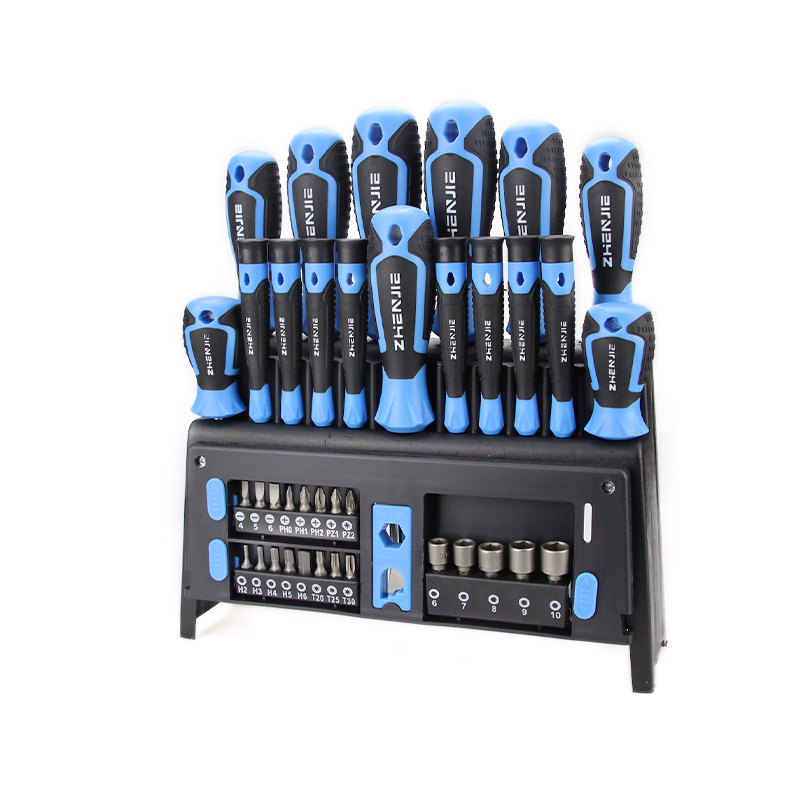
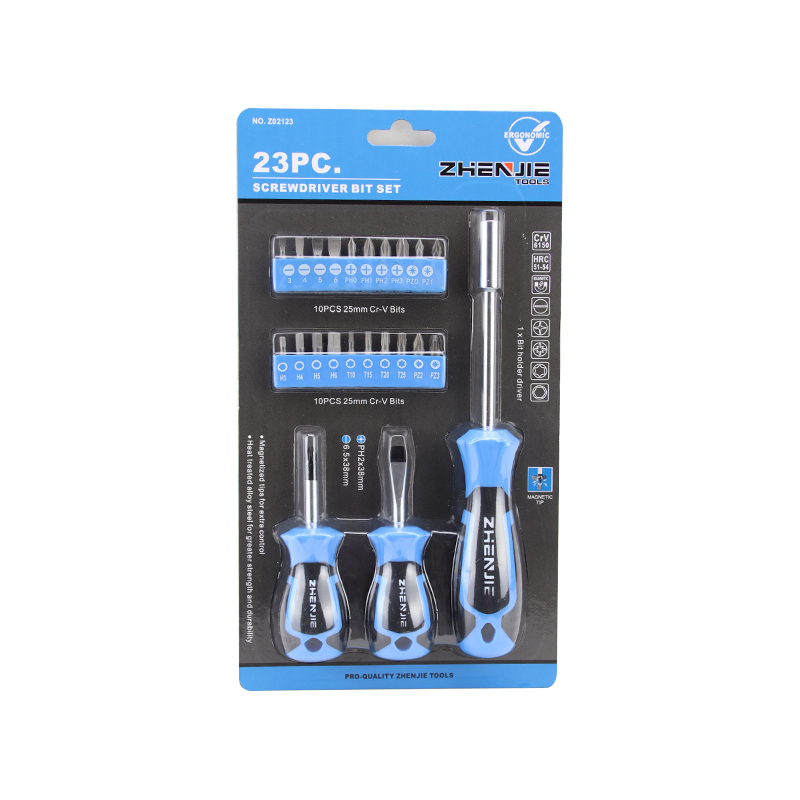 23-Piece Magnetic Bit Holder CRV Screwdriver SetThis CRV bit set offers a balanced hardness around 48 HRC, resisting wear without becoming brittle. It suits mixed wood and machine screw tasks where mild bending is preferable to chipping.View Product →
S2 Steel: Hardness That Resists Wear
S2 bits reach 58-62 HRC and extend edge life, but they trade away ductility and part of their corrosion resistance.
S2 is a silicon-manganese-molybdenum steel designed for shock-loaded tools. In a 1/4-inch hex bit, the high hardness allows a sharper cutting edge, so the bit cuts into a screw head rather than deforming. That translates into longer life on abrasive or hard fasteners, especially when used in an impact driver.
| Property | CRV steel | S2 steel |
| Typical hardness | 46-52 HRC | 58-62 HRC |
| Impact toughness | High | Moderate |
| Wear resistance | Medium | High |
| Corrosion resistance | Good | Fair |
| Best for | General screwdrivers, household bit sets | Impact-rated bits, repeated high torque |
| Relative cost | Lower | Higher |
A common heat-treatment target for S2 bits is 60 HRC with a tempering step that preserves enough toughness for impact use. If the buyer only checks hardness, a brittle 63-HRC batch may pass the QC sheet and fail in the field.
CRV vs S2 Hardness and Toughness: The Core Trade-Off
S2's hardness advantage disappears if the edge chips before it loses sharpness.
For a screwdriver bit, edge retention and chipping resistance are not the same thing. The chart below compares typical behavior of correctly heat-treated CRV and S2 bits across four properties. Scores are relative; higher means better.
Higher is better. Scores reflect typical behavior of correctly heat-treated bit batches.
Rule of thumb: If the bit drives screws manually through mixed materials, CRV fails less. If the bit goes into an impact driver on hardened fasteners all day, S2 lasts longer.
Which Material Works Best for Screwdriver Bit Applications?
The steel should match the driving mode: impact-driven bits prefer S2, while manual general-purpose bits prefer CRV.
CRV for general duty
Retail screwdriver sets, DIY kits, electronics repair, and maintenance tasks are CRV territory. The lower hardness means less edge chipping on slightly off-sized screws, and the corrosion resistance protects bits in plastic storage boxes.
S2 for impact and wear
Impact-rated bits, hardened construction screws, Torx fasteners in drywall, and high-cycle production environments favor S2. The harder edge holds shape longer, and an anti-corrosion coating can offset S2's lower rust resistance.
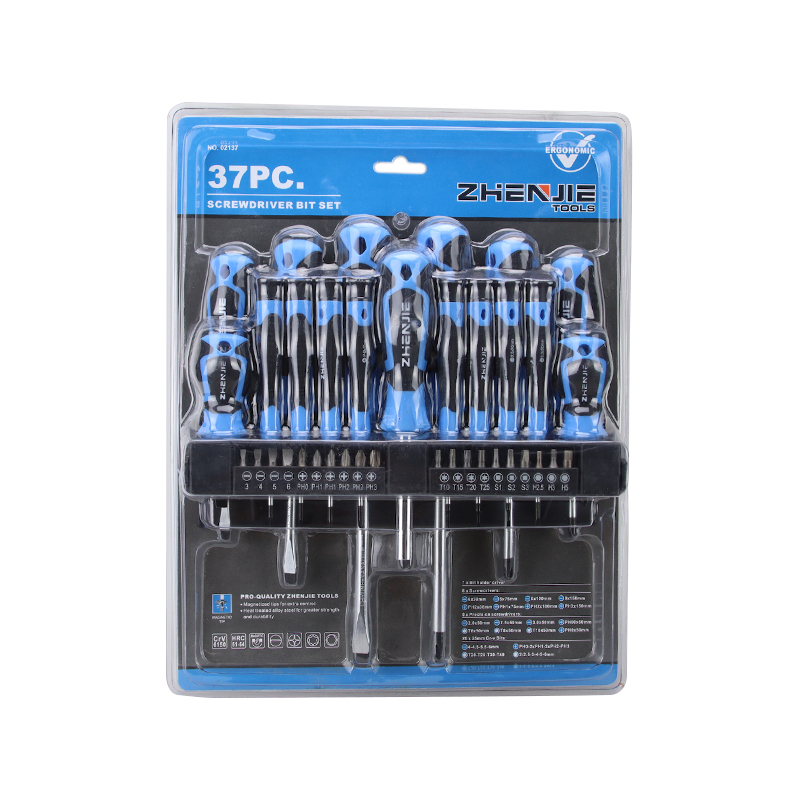
For a balanced OEM assortment, many brands choose a CRV multi-bit set as the main SKU and add a separate S2 impact bit set for professional users. That split hedges cost and performance across two different buyer groups.
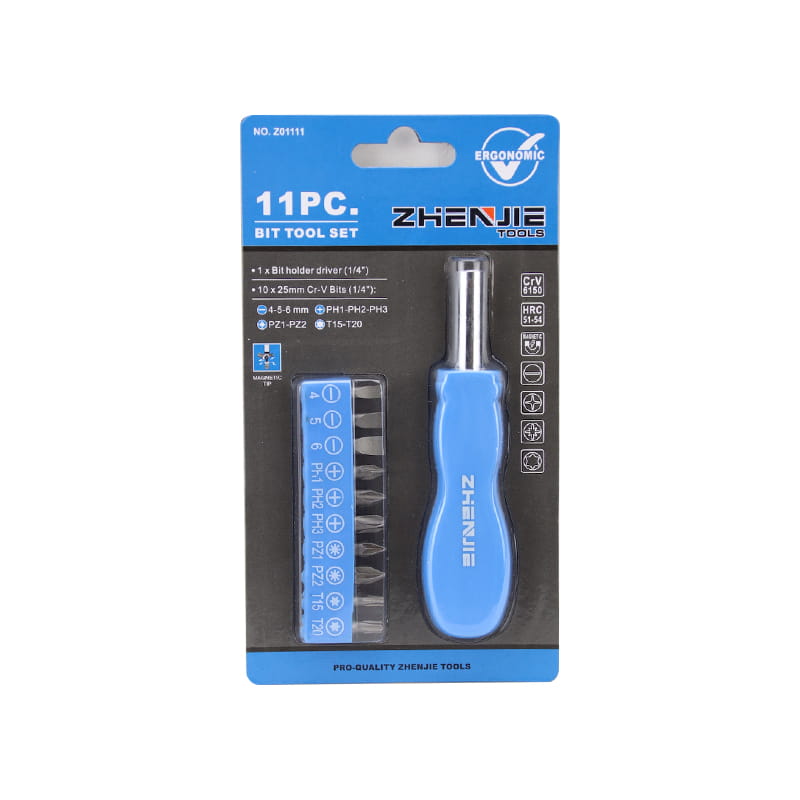 11-Piece Magnetic Tip Bit Holder Driver SetA compact CRV driver set ideal for an OEM assortment, pairing with separate professional S2 impact bits. It provides cost-effective performance for general use while avoiding over-hardened steel.View Product →
Sourcing CRV and S2 Bits: Quality Control Checklist
The steel grade matters less than the heat treatment and quality control behind it.
A 45-HRC CRV bit that was properly oil-quenched can outperform a 62-HRC S2 bit with a rushed temper. In OEM sourcing, buyers should verify the actual hardness range, not just the material name printed on the packaging.
- Hardness test: Request HRC reports for each batch; accept a narrow 5-point range instead of a single headline number.
- Torsion test: Mount the bit in a calibrated driver and apply torque until failure; CRV should bend, S2 should not shatter into multiple pieces.
- Magnetic consistency: Check that the tip holds a standard screw in every bit position; a weak magnet causes the highest complaint rate in CRV bit sets.
- Coating check: Zinc plating or black oxide should survive a 24-hour humidity cabinet test; S2 benefits the most from a coating.
If you are planning a private-label bit set, send us your torque specification and target market. The same geometry can be produced in CRV for retail pricing or S2 for professional positioning. Contact our OEM team to test both steels before ordering.
CRV vs S2 Steel: FAQ for Buyers and Brand Owners
Here are the direct answers buyers ask before placing a screwdriver bit order.
Use this shortcut in the next conversation with your factory: choose S2 for impact-rated professional bits, choose CRV for all-around retail sets, and test a blended assortment before locking your next container.
Can I use S2 bits in a normal screwdriver holder?
Yes. S2 bits use the same standard 1/4-inch hex shank as CRV bits and fit any magnetic bit holder, manual driver, or drill chuck with a hex adapter.
Are CRV bits good enough for Phillips and Torx fasteners?
Yes, for most hand-drive and low-speed applications. The risk appears only when a Phillips or Torx screw is very hard, or when an impact driver sends repeated shock loads through the bit; those cases favor S2.
What is the price difference between CRV and S2 bits?
In wholesale quantities, S2 bits typically cost 20-40 percent more per piece before coating, depending on hardness range and heat-treatment volume. The total impact on a 23-piece set is usually small enough to support a premium product line.
Which steel do screwdriver bit manufacturers recommend for retail sets?
For mass-market pricing and all-round reliability, CRV remains the dominant recommendation. For professional, impact-rated, and high-torque sets, S2 is the better material, especially when combined with a wear-resistant coating.