

 English
 русский
 Español
What Is a Ratcheting Screwdriver?
A ratcheting screwdriver is a hand tool that drives or removes screws using a one-directional ratchet mechanism built into the handle. Unlike a conventional screwdriver, which requires the user to lift and reposition their hand after each turn, a ratchet screwdriver allows continuous rotation in one direction while the handle freewheels on the return stroke. The result is faster fastening with significantly less hand fatigue, particularly on repetitive tasks or in tight spaces where a full 360-degree swing is not possible.
The terms ratcheting screwdriver and ratchet screwdriver refer to the same tool — both names are in common use across trade and consumer markets, with no meaningful distinction between them.
Most ratcheting screwdrivers share three core features:
- A direction selector switch: Typically a collar or lever near the top of the handle that sets the ratchet to drive (clockwise), remove (counter-clockwise), or lock (fixed, functioning like a standard screwdriver).
- A quick-change bit holder: A hex chuck — usually ¼ inch — that accepts interchangeable screwdriver bits, allowing one handle to cover Phillips, flathead, Torx, Pozidriv, and other drive types.
- An ergonomic handle: Wider in diameter than a standard screwdriver handle to increase torque leverage and reduce the number of strokes needed per fastener.
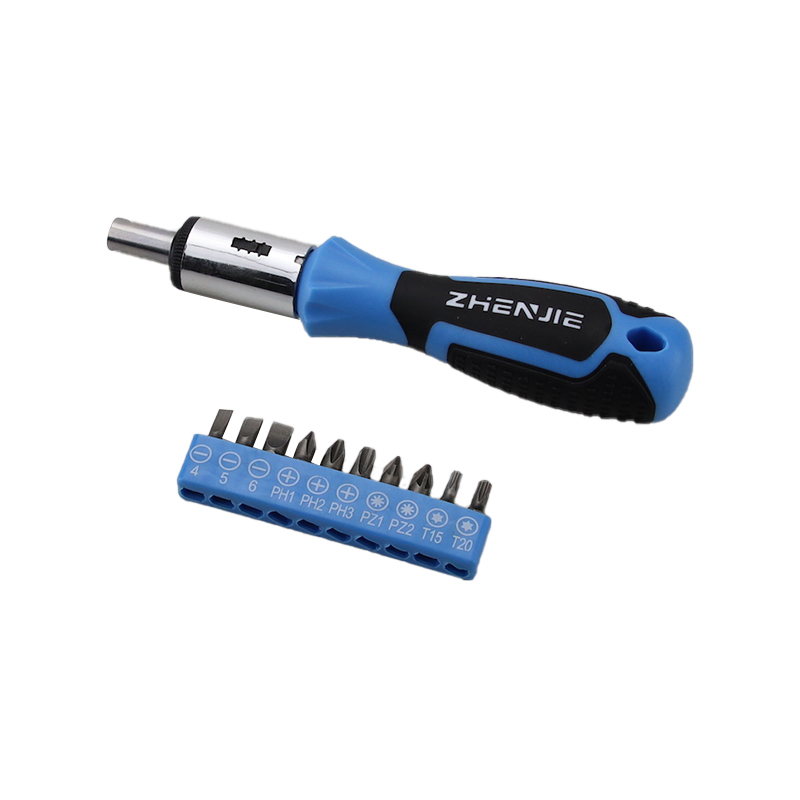
How the Ratchet Mechanism Works
Inside the handle, a toothed gear — the ratchet wheel — engages a spring-loaded pawl. When the handle is turned in the active direction, the pawl locks against the teeth and transmits torque to the bit. When the handle is rotated back in the opposite direction, the pawl rides over the teeth and disengages, allowing the handle to return without turning the bit or the fastener.
The number of teeth on the ratchet wheel determines the tool's swing arc — the minimum angle of rotation needed before the next tooth engages. A finer-tooth ratchet (more teeth, typically 60–72) requires a smaller swing arc, making it more useful in confined spaces. Budget ratcheting screwdrivers often use coarser tooth counts (24–36), which require a wider arc and can skip in tight quarters.
The direction selector switch physically repositions the pawl against the ratchet wheel — flipping it to the opposite face of the teeth to reverse the active and freewheeling directions, or centering it to lock both faces simultaneously for fixed-drive mode.
How to Use a Ratchet Screwdriver
Using a ratchet screwdriver correctly takes only a few moments to learn, but a handful of technique points make a measurable difference in speed, control, and bit longevity.
Step 1 — Select and Fit the Right Bit
Match the bit type and size to the fastener head before applying any torque. Using a PH2 bit on a PH1 screw, or a worn bit on any fastener, is the leading cause of cam-out — the bit slipping out of the drive recess and damaging both the fastener and the workpiece. Press the bit firmly into the hex chuck until it clicks into the magnetic or spring-ball retention seat.
Step 2 — Set the Direction Selector
Rotate the direction collar to the correct setting before touching the fastener. For driving screws, set to clockwise (often marked with a right-pointing arrow or a "+" symbol). For removal, set to counter-clockwise. Confirm the setting by making a short test stroke — you should feel resistance in one direction and free movement in the other.
Step 3 — Apply Axial Pressure and Drive
Seat the bit fully in the screw head and apply firm forward pressure along the axis of the fastener throughout every stroke. Axial pressure is as important as rotational force — inadequate pressure allows the bit to rock and cam out, even with the correct bit size. Grip the handle in the palm and use short, wrist-driven strokes rather than full forearm swings; this keeps the bit seated and gives better control over torque.
Step 4 — Use the Lock Mode for Final Tightening
Switch the direction collar to the locked (fixed) position for the final quarter-turn on critical fasteners. The ratchet mechanism introduces a small amount of play inherent to the tooth-and-pawl design, which reduces feel and precision at the point where controlled final torque matters most. Finishing in locked mode gives the same solid feedback as a conventional screwdriver and reduces the risk of over-torquing.
Tips for Confined Spaces
When the swing arc is restricted to less than 30 degrees — inside a cabinet, behind a panel, or between joists — a fine-tooth ratcheting screwdriver outperforms a standard one immediately. Hold the handle between thumb and forefinger rather than in a full palm grip, and use short finger-driven flicks on the return stroke. If access is too restricted even for this, most ratcheting screwdrivers accept a ¼-inch hex bit in a right-angle adapter, which rotates the drive axis by 90 degrees for truly impossible angles.
Ratcheting Screwdriver vs. Standard Screwdriver: When Each Makes Sense
A ratcheting screwdriver is not a universal replacement for a standard screwdriver — each has scenarios where it is the better choice.
The ratcheting version wins on speed and endurance for tasks involving multiple fasteners, repetitive assembly work, or screws in awkward positions. Electricians, furniture assemblers, and appliance repair technicians typically reach for a ratcheting screwdriver as their default hand tool for exactly this reason.
A standard screwdriver is still preferable for single precision fasteners where maximum tactile feedback is required — such as small electronics screws, delicate hinge adjustments, or any application where the risk of stripping demands absolute torque control with no mechanical play. It is also the more reliable choice when the fastener is partially stripped and requires steady, sustained pressure without any rotational slip.
For most general-purpose toolkits, a ratcheting screwdriver with a set of interchangeable bits replaces the need to own multiple fixed screwdrivers across drive types, making it both a space-efficient and time-efficient choice.